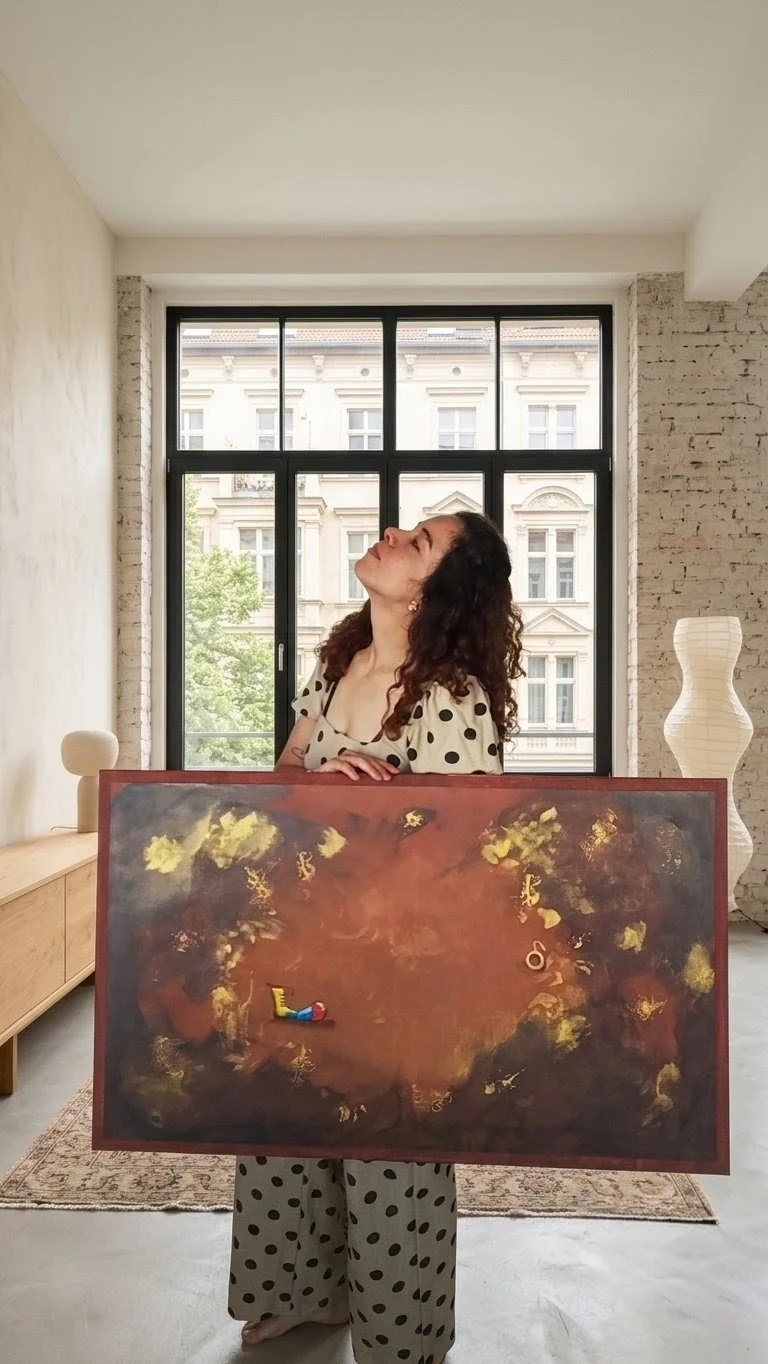
What Is on the Canvas — and Why
My research interrogates identity as an unstable, fragmented architecture rather than a fixed entity. I view the canvas as a site of negotiation, where experiences of dislocation, loss, and reconstruction materialize through physical tensions, resistances, and a perpetual search for tonal resonance. Abstraction allows me to bypass illustrative narrative in favor of a cathartic ontology, constructing a visual field where meaning remains unresolved and in a state of constant slippage.
The central conceit of my work is the formation of identity as a collection of disparate fragments. I operate through successive stratifications, employing mixed media and natural fixatives to allow traces of collapse and rebirth to coexist upon the surface. The pictorial plane functions as a territory of mediation—an unstable archive of gestures, erasures, and sedimentations.
Alongside abstraction, my practice investigates the figure of the clown as a psychological and symbolic device. Historically suspended between comedy and tragedy, the clown embodies the paradox of visibility and concealment, exposing the fragile threshold between authentic emotion and performed identity. Through this recurring presence, I examine the social masks individuals construct to negotiate vulnerability, belonging, and survival. These masks are neither disguises nor deceptions, but adaptive structures—protective surfaces that both reveal and obscure the self. The clown becomes an archetype through which emotional contradiction, childhood memory, and the instability of identity converge.